Posts

Showing posts with the label water quality

Water Quality in India and its Impacts

Image
Water Quality in India and its Impacts By: Blessen Kuriakose Clean drinking water is often viewed as easily attainable and accessible to some, while many view it as a luxury. Though it is necessary to sustain life, many take it for granted. Countries like India exemplify the actual value of drinking water and its importance to life. Freshwater is commonly found in India in surface water sources such as wetlands, lakes, rivers, ponds, springs, cave waters, etc. USGS defines freshwater as the "supply the human population, animals, and plants with the fresh water they need to survive." Though freshwater is necessary for sustaining life, it is found in slight traces throughout the planet, with only 2.5% of the water on earth being freshwater. Much of this freshwater is often contaminated and polluted by human intervention. In countries like India, clean drinking water is commonly found in scarcity. With a population of nearly three times that of the United States, only less than ...
Long Island Drinking Water and Contaminants

Image
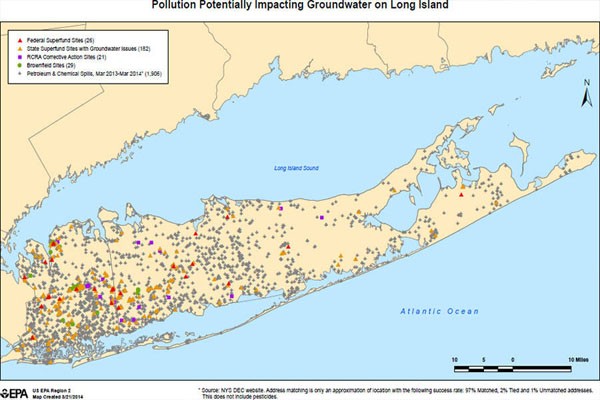
By: Andrew Zhang Take a sip and think. Where does your drinking water come from? Water from every tap, fixture, and faucet on Long Island is pumped up from underground aquifers despite being surrounded by water. The very lifeforce of Long Island is contained within these underground reservoirs, but very few people actually know how these function or how they are affected by industry. National Geographic defines an aquifer as “a body of rock/ sediment that holds groundwater,” and Groundwater is defined as “precipitation that has infiltrated the soil beyond the surface and collected in empty spaces underground.” The Long Island aquifer is an unconfined aquifer, which lies beneath a layer of permeable soil, compared to a confined aquifer with a layer of consolidated rock above. The three principal Long Island aquifers, the Upper Glacial aquifer, the Magothy aquifer, and the Lloyd aquifer, are composed of layers of sand and gravel deposited by glacial movement some 10,000 years ago. Th...

A surge in algae and nitrogen are harming our water supply! What can we do to fix it?

Image
By: Robert Kelly What is the current situation? Throughout Long Island, there are nearly 500,000 conventional cesspools and conventional septic systems releasing harmful contaminants into our water supply. Nitrogen is one of the most dangerous contaminants. Though nitrogen is a naturally occurring element, excessive and uncontrolled amounts of it can result in a surge of algal blooms, which poison our shellfish, kill ecosystems, and change the way we interact with the ocean for the worse.   Long Island's war against algae blooms has dated back to the mid-1980s. The surge in these blooms harms shellfish and other bottom dwellers by depriving them of the oxygen they need to survive or releasing many toxins that have the same effect and kill ecosystems. Another adverse impact of algae blooms is that they block essential nutrients and sun rays needed by plants such as eelgrass, causing them to die. Does this problem only affect oceanic communities, or is there more to the story? T...